

Science Subscription Box for Kids In 2026 Review – Science Experiments at Home
A science subscription box firm called MEL Science uses VR/AR and hands-on experiments to get kids interested in science. Aged 5 to 16+. It expands access to top-notch science education to more than 60 nations worldwide. Educating your children in actual science in an entertaining way. Encourage a passion for science in your children with regular hands-on activities and instructive digital encounters.
Disclosure: Links here are affiliate links, at no additional cost to you, I will earn a commission if you click the link and make a purchase. Respective website(s) are responsible for any product’s warranty or other things!
Does MEL Science Pay Off? Yes, MEL Science is unquestionably worthwhile for anyone with kids who are into STEM (science, technology, engineering, math), or even youngsters who aren’t into STEM but have some free time. This is because the exercises are made to be both entertaining and instructional.
MEL Science offers educational subscription boxes that include amazing hands-on experiments and are supported by live online classes and immersive AR and VR sessions. Their goods are perfect for homeschooling parents, scientific teachers, schools, and budding scientists aged 5 to 16 and up.
With their Montessori-approved Robotics kit and computer with voice assistant, your children may learn the fundamentals of computer programming without using a screen. Build green STEM models, shoot off rockets in augmented reality, and engage in play-based learning. Create functioning replicas of commonplace equipment to comprehend their operation and conduct virtual reality physics research. Get your own chemical lab, carry out secure scientific investigations, and use virtual reality to explore molecules.
1. MEL Science STEM course:
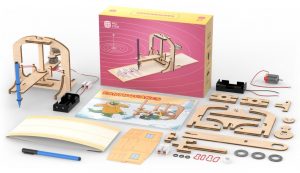
At checkout, select the STEM course. With monthly hands-on crafts and instructive digital experiences for your children, begin an adventure into science. Ages 5–9+. Beginning at $20.90 a month. You can change to a different course at any moment, stop your subscription, or end it altogether. Get a fresh collection every month that includes kid-friendly experiments and instructions. STEM kits that you may interact with. Monthly delivery to your home. Safe certification is filled with everything your children require. Packed with family-friendly entertainment.
Green Flashlight:
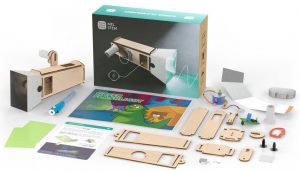
Do you think it’s possible to run a flashlight just on the strength of your hands? Nothing magical or funny—just science! With the “Green Flashlight” kit from MEL Science, you can assemble a genuine dynamo flashlight while learning about green energy principles.
You will:
Build a genuine crank flashlight with an accumulator, experiment with ultraviolet light, and employ different light sources for their flashlight!
You will learn:
About the batteries that power flashlights, what an accumulator is, and how and where solar panels are employed!
Codebreaking:

Have you ever considered sending a pal a secret message? If so, MEL Science’s “Codebreaking” collection will be quite helpful to you in solving this. Discover several message encoding methods, then try them out in real life!
You will:
Encrypt and decrypt communications; put together a functional transmitter and encryption tools; try various encryption methods.
You will learn:
What Morse code and encryption are, how an electrical circuit uses LEDs, and how to encode a hidden message!
Art Lab:
Have you ever seen stunning works of fine art that were created using a range of paints? With the “Art Lab” from MEL Science, find out more about paints and how they are made and get a quick overview of the structures of various substances!
You will:
Make their own paints, put together a paint organizer, and mix colors to make new ones!
You will learn:
What are primary and secondary colors, how are paints manufactured, and what materials are used to make various things?
Printing Press:
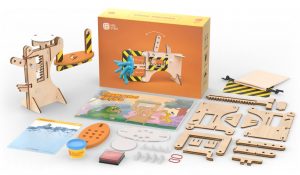
How tightly can your hand squeeze something? Maybe not much, at least not until you add science! You can compress a variety of things with just one finger if you use the “Printing Press” kit from MEL Science! Perform a fun experiment to convert a press into a lift while learning about pressure and forces!
You will:
Get a real press and a real lift together; Watch how various items are affected by pressure; Make up your own heavy-lifting exercise!
You will learn:
The fundamentals of force and pressure; How a press operates; Interesting facts about the capabilities of presses!
Microscope:
Did you know that certain items are so little that the human eye cannot perceive them? With the aid of your smartphone, the “Microscope” kit from MEL Science will reveal this secret realm to you! Find out what little organisms are around you and how common objects appear when magnified!
You will:
Build a functional microscope; Prepare and analyze various specimens; Capture specimens in microscopic images.
You will learn:
Utilizing an optical microscope, how to acquire a microscopic photograph of a tiny critter in focus!
Aircraft:
Have you ever considered how heavier-than-air objects like helicopters and airplanes can so effortlessly soar through the sky? MEL Science’s “Aircraft” set will investigate how this operates. Learn about the history of human flight by launching disks, boomerangs, and propellers!
You will:
Build two different rockets, try out various airfoils, and investigate the aerodynamic characteristics of various materials!
You will learn:
The history of various types of aircraft, what an airfoil is, and how lift force works are all discussed along with why some objects can fly.
Infinity Portal:
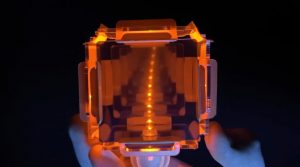
Ever questioned why your image seems the way it does in a mirror? Why isn’t it turned around? Why are you unable to see your own back? Utilize MEL Science’s “Infinity Portal” tool to discover the solutions! Build an unlimited reflection tunnel by studying the physics of reflections!
You will:
Build a light corridor that is “impossible”. Play around with angles and reflections. Make your own original reflection artwork.
You will learn:
The principles governing light reflection. Basic concepts in geometrical optics where reflections and mirrors are employed in daily life.
Earthquakes:
What are the causes of earthquakes and how do they work scientifically? We’ll need to investigate the Earth’s structure to get the answers to these issues, and MEL Science’s “Earthquakes” can be useful. Investigate the underlying workings of our planet and discover how to develop structures that are as earthquake-resistant as possible!
You will:
Put together a seismograph; Seismograph: use it to record vibrations; View the effects of vibrations on a paper “structure”!
You will learn:
What an earthquake is; the fundamentals of the Earth’s structure; and how earthquake-resistant buildings are made!
Spectrum Goggles:
Describe color. How do rainbows form? How is 3D vision implemented? How do animals and insects perceive the environment? The “Spectrum Goggles” set by MEL Science has the answers to these and many other questions concerning the science of light, colors, and vision.
You will:
Build actual 3D goggles, investigate light and color theory, and uncover hidden messages only visible through their goggles!
You will learn:
About the visual systems of animals and insects, the fundamentals of color mixing and spectrum, and how optical filters are used in daily life!
Spring Force:
Which do you prefer, a car that can go incredibly fast or one that can go incredibly far? With the “Spring Force” set from MEL Science, you may build while using science and cunning! Learn how to use mechanical advantage and reduce friction to improve your racecar. Save your energy!
You will:
Build a racecar with a spring engine to test their knowledge of energy conservation principles and build their own motor with pulleys and levers.
You will learn:
Friction’s significance in many mechanisms, the fundamentals of mechanical advantage regarding the conversion of energy in daily life.
Electric Boat:
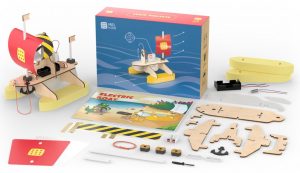
Have you ever seen drones that propel themselves using electric motors? Do you realize that these engines aren’t just for use in aircraft and helicopters? With the “Electric boat” package from MEL Science, you can build a miniature boat that can sail in addition to building your own electricity-powered propeller.
You will:
Build a boat from scratch, build an electric-powered propeller, and combine the two to make the boat sail!
You will learn:
What makes a boat sail, the components of an electric engine, and many other fascinating details about ships, boats, and sailing!
Gyroscope:
Have you ever wondered why it takes a spinning top so long to fall? With MEL Science’s “Gyroscope” kit, you can learn more about the stability of rotating bodies. What exactly is a gyroscope and how does it function in contemporary technology? Describe precession. 3D AR demonstrations will make your head spin!
You will:
Make a homemade toy gyroscope. Watch how your gyroscope behaves. Calculate a gyroscope’s maximum spin time.
You will learn:
Defining precession; The mechanism governing the stability of rotating objects; Gyroscope applications in real life.
Projectile Сannon:
We have all experienced the agony of attempting to throw a crumpled piece of paper across the room into the recycling bin. Use the “Projectile Cannon” set from MEL Science to advance your skills! Discover how the launch angle impacts an object’s trajectory, what angle is best for the furthest launch, and how to utilize the AR app’s interactive target practice to improve your aim!
You will:
Construct their own toy gun, play a game that explores projectile velocity, and develop their aim!
You will learn:
What is a trajectory, what are angles and velocity, and what about sports parabolas?
Science of Light:
You are probably appreciating the work of polarizers when using your smartphone to browse the internet. But what are polarizers exactly, and how do they work? How do they treat the light? What exactly is light? The “Science of Light” set by MEL Science allows you to investigate the origins of light and its interactions. Build your own screen and discover how polarizers function with 3D images in the AR app.
You will:
Construct a screen model; watch how a translucent object affects the way light behaves; design a picture that can only be seen on their screen!
You will learn:
About the properties of light, what a polarizer is and how it functions, and situations in which polarizers are employed in daily life!
Hydraulic Lift:
Begin your fascinating journeys on a distant planet! With the “Hydraulic Lift” kit from MEL Science, you can discover practical applications for hydraulics and construct your own jack lift!
You will:
Construct a simple hydraulic system, investigate the operation of a scissors mechanism, and put together a model of a real jack lift!
You will learn:
Learn the properties of matter, how hydraulic systems function, and practical applications of hydraulics!
2. MEL Science Math course:
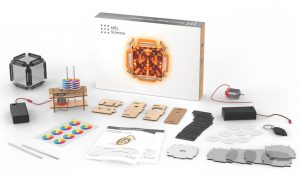
Math education for children in a pleasant way. Get interactive materials and in-app experiences that will pique your children’s interest. Ages 8+. Exciting math kits that you can use. Monthly delivery to your home. Safe certification is filled with everything your children require. Packed with family-friendly entertainment. Your children will learn probability theory and never lose. Kids learn math more effectively and enjoyably with hands-on math kits (and parents).
Unbeatable games:
Your children will learn probability theory and never lose.
Infinity cube:

With your children, investigate how math concepts are used in everyday life.
Geometric designs:

Let your children experience the allure of math.
Making math simple:
Our enjoyable and interesting hands-on arithmetic kits are guided by step-by-step videos for your youngsters.
A new kit every month:
Fun math experiments are delivered to your house.
3. MEL Science Physics course:
At checkout, select the Physics course. Make science engaging for your children with regular hands-on activities and instructive digital experiences. Ages 8–14+. Beginning at $20.90 a month. You can change to a different course at any moment, stop your subscription, or end it altogether. Purchase a physics kit that includes a few hands-on experiments each month, and learn how things operate! With hands-on teaching kits sent each month, you can teach your children the mysteries of physics and cultivate a passion for the subject.
Heat transfer:
Heat and cold are all around us. You will understand what heat is and develop the ability to see it with the help of the “Heat Transfer” set from MEL Science. Discover how evaporation may be used to cool objects, and see how various objects can transmit heat differently through themselves!
You will build:
A tool demonstrating the impact of temperature on water evaporation, a heat racing installation.
You will learn:
Observe how warm your hands and breath are. Discover the definition of heat and how it is transmitted. Boiling water is used to cool an object. See how various things affect heat transfer.
Liquiosity:
Liquids. You come upon them each day. You believe they can’t shock you, do you? Please hold my cup of non-Newtonian liquid as we demonstrate something to you. Open the MEL Science “Liquiosity” set and start studying liquids straight away. Prepare a fluid that responds to a violent blow to see how amazing viscosity experiments may be!
You will build:
Real-world viscosity experiment setup; A slime that is anything but typical; A fluid bloom!
You will learn:
Learn about the molecular characteristics of fluids and viscosity. Create non-Newtonian liquid on your own. Play with a liquid that contains very lengthy molecules.
Vision physics:
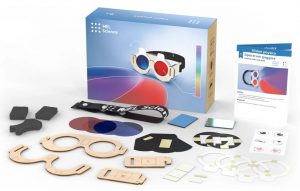
Describe color. How is 3D vision implemented? How do animals and insects perceive the environment? The “Glasses” set by MEL Science has the answers to these and many other questions regarding the science of light, colors, and vision.
You will build:
Actual 3D glasses, Penguin vision goggles.
You will learn:
Learn about the vision of animals and insects. Examine the attributes of light and color. Utilize your new goggles to discover hidden messages.
Magnipulation:
In our daily lives, magnets are incredibly common, and occasionally their characteristics are downright odd. The “Magnipulation” set from MEL Science will teach you more about magnetic qualities. You will use your expertise to build a magnetic lock and slow the fall of a magnet without touching it!
You will build:
A configuration where a magnet progressively drops without any obvious cause, a magnet-based lock.
You will learn:
Learn about the characteristics of magnets. Design a magnetic lock. Magnet fallout is gradual.
Gyroscope:
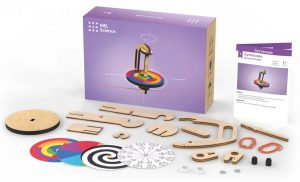
The gyroscope is a wonderful innovation with exceptional qualities and the capacity to stay balanced in any circumstance. Use the “Gyroscope” set from MEL Science to learn more about it! You’ll see intriguing optical phenomena and use what you learn to experience how a gyroscope can withstand your might!
You will build:
Handle for a gyroscope, optical effects with a spinning top.
You will learn:
Discover gyroscopes and their characteristics. The gyroscopic effect is felt. Create a rotating top with swappable images.
Magnetic levitation:
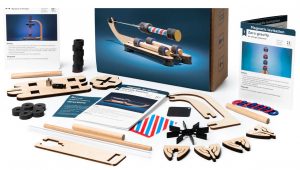
You have probably come into contact with magnets countless times throughout your life, but do you really understand what they are capable of? You will learn more about magnets and their characteristics with the “Magnetic levitation” set from MEL Science. Make a rod levitate by harnessing the force of magnets!
You will build:
Levitating magnetic elevator rod, a propeller that is supported covertly.
You will learn:
Discover magnetic poles; Investigate the interactions between magnets by making a rod levitate; Create a standing propeller support using an unseen magnetic field.
Spectrum:
It turns out that you can combine colorful light rays as well as paint colors! You can discover what primary colors are and how to mix them to make new ones with the “Spectrum” set from MEL Science. Additionally, you’ll discover how to create white light!
You will build:
The spectrometer is a device that can mix colors and tint shadows.
You will learn:
Find out what light is. Learn color blending techniques using a colored cube. Create vibrant shadows. Build a contraption that emits rainbows from light.
Vacuum:
You can feel the strength of the air by withdrawing it from one place. You will discover how to eliminate the air and make use of it by using the “Vacuum” set by MEL Science! Learn how to boil water with a vacuum and what it is!
You will build:
Setup for a vacuum camera. An instrument for measuring suction. Boiler for low temperatures.
You will learn:
The definition of a vacuum. Make a vacuum, then gauge it. Utilize a vacuum to boil water.
Aerodynamics:
The air around us has tremendous force; it can move ships, bend trees, and do so much more. Do you wish to harness its strength? With the “Aerodynamics” kit from MEL Science, explore the power of air! Study airflows while holding a ball in the air!
You will build:
A vortex gun. A machine that uses a wind tunnel and can suspend a ball in the air.
You will learn:
The strength of various airflow types. How an airflow develops. Build a vortex cannon.
Electrostatics:
The idea that electricity is only found in wires and circuits is a widespread one. In actuality, electricity is concealed in a variety of home goods, including you. You can learn about one approach to producing electricity and use it to launch foil molds by using the “Electrostatics” set from MEL Science. Additionally, you’ll learn how friction and electricity are connected!
You will build:
Touchscreen electrostatic. Machine for electrostatic launching. Hair-raising equipment.
You will learn:
A Van de Graaff generator’s definition is a way to produce electricity. Fly foil molds in the air. Make the tinsel stand up.
Lenses:
A beam of light appears to be intangible because you cannot see or touch it as it moves through the air. Even so, you will discover how to utilize lenses to disclose and control a laser beam and even how to make a little object invisible with the “Lenses” set by MEL Science!
You will build:
Laser fork; Light-bending apparatus; Circular microscope.
You will learn:
View how various lenses affect a laser beam. Imagine the beam’s course. How a popsicle stick may be hidden by a lens. Use a laser and a spherical lens to produce strange visuals.
Luminescence:
You may already be aware that light may cause certain objects to go through specific processes; just consider how plants produce oxygen when the sun shines on them. But light has so much more potential! The “Luminescence” set by MEL Science teaches you about light energy and some of its uses.
You will build:
Many beautiful images; Nightlight in a liquid; a Device that uses light to create enigmatic images.
You will learn:
How to leave a note that other people can’t see. Make a homemade fluorescent nightlight. How to use light to sketch.
Alternative energy:
Energy production takes up a sizable percentage of human resources. How many different types of energy can you name? Which ones are safe for our planet, and which ones? Learn about heat, sun, and wind energy by opening the MEL Science “Alternative energy” set.
You will build:
Tiny wind turbine power plant. Portable solar energy system. A power generator.
You will learn:
Make your own wind turbine. Investigate and become familiar with a variety of energy sources. Watch the transformations of energy.
Electric motor:
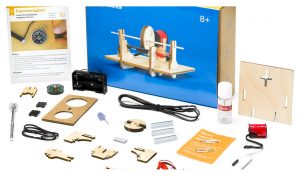
Would you be interested in finding out how to make a magnet with electricity? Looking to convert movement into electricity and vice versa? The solutions are in the “Electric Motor” set from MEL Science! You’ll also build your own electric motor!
You will build:
Electric generator; Electric motor; Electromagnet.
You will learn:
Use a battery and a wire to make a magnet. Make an LED glow without using batteries. Create your own electric motor.
Reflections:
You may not be aware, but every mirror contains a fascinating mirrored universe. With the “Reflection” set from MEL Science, discover this universe and learn about the science of reflection! Make an unending mirror tunnel by practicing with one-way mirrors.
You will build:
Numerous reflections; a one-way mirror; and an Infinity tunnel that is portable.
You will learn:
Examine the nuances of various reflections. Find out how a one-way mirror functions. Make a transportable tunnel of infinite mirrors.
Hydrophobicity:
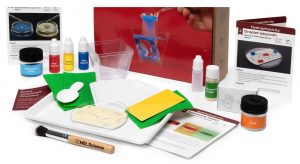
Love the water? Whatever your response, you’ll find content that supports it. You’ll utilize physics to manage this essential liquid with the “Hydrophobicity” set by MEL Science! The power of knowledge!
You will build:
The droplet maze. Hydrophobic sand figurines submerged in the ocean. A collection of droplet profiles on various materials.
You will learn:
Water droplets, lead them! Make a dry sand that will never rain! Use water droplets to investigate various surfaces!
Polarized light:
Polarization is one of the many intriguing characteristics that light possesses. The “Polarized Light” package by MEL Science allows you to discover light’s mysteries and use them to produce beautiful works of art. Utilize polarization’s potential to show how intricate transparent polymers are despite their seeming simplicity!
You will build:
A light filter. Polarized screen on wheels. Polarized mosaic of light.
You will learn:
A light filter. Polarized screen on wheels. Polarized mosaic of light.
4. MEL Science Chemistry course:
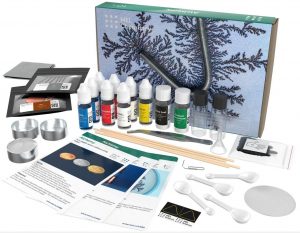
Your children can learn chemistry in a pleasant way. At checkout, select the Chemistry course. With monthly interactive activities and instructive digital experiences for youngsters, explore the excitement of science. Ages 10–16+. Beginning at $20.90 a month. You can change to a different course at any moment, stop your subscription, or end it altogether. Every month, get a chemistry set for kids with a few experiments sent. A starter kit and VR headset are also included with the initial shipment!
But will it burn?:
It’s simple to picture burning wood or paper. Would you anticipate soap foam to burn, though? or even steel? MEL Science’s “But will it burn?” set will test your ability to ignite objects that ordinarily seem inflammable! Discover how to create flammable foam and even ignite some iron!
You will:
Enjoy burning iron wool by getting some hydrogen foam and setting it on fire.
You will learn:
What is combustion, and what materials may burn it?
Colorful chemistry:
Bright, changing hues usually capture our attention. But did you realize that some of these vibrant changes have a strong chemical foundation? Learn more about pH indicators and the colors they can acquire under various circumstances by using some fun patterns. You will undoubtedly have a lot of fun if you pair the “Colorful Chemistry” kit from MEL Science with the well-known “Color Shifting Milk” experiment.
You will:
Try experimenting with liquid soap, milk, and colors. Find out how thymol blue reacts to variations in solution pH. Make a magic liquid that, depending on its pH, changes color.
You will learn:
What pH indicators are what surface tension is, and what acids and alkalis are?
Crystals:
When you hear the word “crystal,” what comes to mind first? Right, fascinating faceted stones? Utilize the MEL Science “Crystals” set to cultivate some of your own! Admire frosty urea patterns, take in the geometry of crystals formed from solutions of copper sulfate and potassium ferricyanide, and discover what pyrite is made of!
You will:
“Freeze” a Petri dish with urea crystals to produce stunning crystals from copper sulfate and potassium ferricyanide solutions. Dissolve pyrite to reveal its chemical composition.
You will learn:
What causes salt crystals to form in solutions? The characteristics of pyrite and what causes a substance to change from one condition to another.
Zinc-carbon battery:
What are batteries constructed of and how do they function? With the “Zinc-carbon battery” kit from MEL Science, discover the world inside the most typical energy source! You’ll build your own batteries that you may use to power an LED or a clock. Additionally, you’ll create “liquid wires” to create an electrically conductive pattern!
You will:
Discover how to construct a battery. Make “liquid wires” that you may use for drawing.
You will learn:
How batteries function. What substances are electrically conductive?
Diffusion:
Iodine can leak out of a plastic bag or show a fingerprint, did you know that? And that you may see gorgeous chemical reefs develop before your eyes in a Petri dish? Diffusion is the common phenomenon that underlies all of these studies! Use the MEL Science “Diffusion” set to learn more!
You will:
Watch iodine leak from a plastic bag, build a reef in a Petri dish, and use iodine to detect a fingerprint.
You will learn:
What happens when ionic chemicals interact chemically? That response is called diffusion, and it can be used to identify fingerprints.
Chemistry of winter:
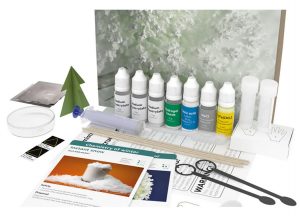
Did you realize that chemistry can even contribute to the festive spirit of Christmas? Check it out using the MEL Science “Chemistry of Winter” set! Create some fake snow with sodium polyacrylate and potassium ferrocyanide, then use it to decorate a little Christmas tree!
You will:
Purchase fake snow, discover sodium polyacrylate, and decorate a Christmas tree with salty “snow”.
You will learn:
About substances that consume water. What causes salt crystals to form in solutions?
Cyanotype:
In the 19th and 20th centuries, technical drawings of structures and ships were copied using cyanotype, commonly referred to as the blueprint process. The “Cyanotype” set allows you to try it out; nowadays, amateurs are the ones who use it the most. Make a replica of the well-known Great Wave off the coast of Kanagawa. Additionally, you’ll get a chance to draw with an LED and discover some interesting facts about Prussian Blue, a stunning blue color.
You will:
Learn to use a diode to create art, and make a light-based image.
You will learn:
What do light-sensitive substances do in cyanotype?
Chemistry & light:
What can cause a solution to glow at night? Actually, chemistry can do that! With the “Chemistry & light” set by MEL Science, you can create bright nebula-like solutions in vials, make your own glowing galaxy in a beaker, and discover what happens if specific minerals are heated in the dark.
You will:
Admire your very own galaxy in a beaker as you investigate what occurs when marble and fluorite are heated to produce dazzling chemical nebulae.
You will learn:
What causes some substances to glow? A definition of an oxidation-reduction reaction.
Etching and Plating:
Since ancient times, metals have been utilized to create ornamentation. But what metallic accessories can we produce using chemical processes? You can find out by looking at the MEL Science “Etching and Plating” set! Watch as metals precipitate and dissolve directly in front of you by applying electricity or a copper sulfate solution on iron plates, setting up “copper fights” between metallic copper and copper ions, or both!
You will:
Get copper patterns that resemble rainbows on an iron plate. Examine the interaction between metallic copper and copper ions by electrically painting a picture on a plate of iron.
You will learn:
Defining metal etching. How to make a thin sheet with unique optical characteristics. How to use a chemical reaction to print an electrical circuit.
Pure water:
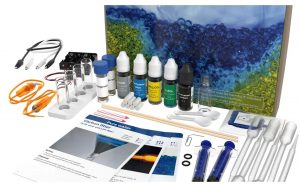
Life requires access to clean drinking water, yet in the current period, there are many new sources of water contamination. You will assemble two different kinds of water filters and purge water samples of organic and heavy metal pollutants using the “Pure Water” package from MEL Science. Discover how electrolysis affects water as well as a fascinating technique for producing pure water.
You will:
Using a homemade filter, cleanse the water. Make a filter that removes heavy metals from water. Learn how to use water electrolysis to create an oxyhydrogen combination.
You will learn:
Workings of carbon water filters. How to utilize ion-exchange resin in a water filter and what it is. Defining electrolysis.
Chemistry & electricity:
Have you ever considered the methods used to produce electricity? You can find some information in the “Chemistry and Electricity” package from MEL Science. You’ll discover how to use a common lemon to light an LED and put together a Daniell cell, one of the earliest chemical generators of electricity.
You will:
Recreating one of the early chemical electric cells. The use of a lemon to ignite a diode.
You will learn:
What a galvanic cell is and how it generates electricity.
Oxygen:
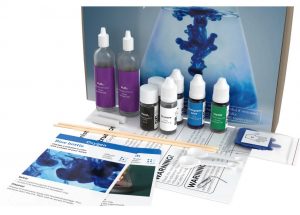
How can you light a burning splint without a match or a lighter? And how does simply stirring a solution change its color? The “Oxygen” collection by MEL Science contains the answers to these queries. Have fun with the activities as you learn about the characteristics of oxygen, the gas to which we owe our entire lives.
You will:
Shaking your hand will instantly turn a colorless solution blue. Smolder a splint and light it on fire in pure oxygen.
You will learn:
What specific characteristics of oxygen act as oxidizers and reducers?
Artificial sea:
Humans have always been drawn to the seas by their beautiful scenery and incredible undersea environment. The nearest sea is frequently very far away from you, but “Artificial Sea” by MEL Science allows you to make a tiny sea at home! With the use of chemistry, you can grow seaweed in a beaker, make a colored jellyfish in a Petri dish, and convert an ocean wave into stone!
You will:
Seaweed can be grown synthetically in a potassium ferrocyanide solution. One drop of a salt solution can be used to create colored jellyfish, and it hardens in a matter of seconds.
You will learn:
Osmosis is the process by which ionic compounds react with one another. Liquid glass has certain qualities and capabilities.
Tin:
Have you ever heard of Hans Christian Andersen’s fairytale, “The Steadfast Tin Soldier”? Do you wish to discover more about tin, the metal from which the legendary soldier was fashioned? With the help of electricity, you can build dendrite-like structures and transform a zinc pellet into a cute hedgehog with the MEL Science “Tin” kit, which will demonstrate just how lovely tin can be.
You will:
Grow a tiny tin hedgehog on a zinc pellet’s surface and observe lovely tin dendrites developing in a Petri dish.
You will learn:
About how different metals respond differently. How a chemical reaction is brought on by electric current.
Egyptian night:
Did you know that night falls more quickly the closer you are to the equator? A fun demonstration can be provided via chemistry! Get your own beaker of “sky” that rapidly darkens! Do you also want to be amazed at the moon? Make it come out of nowhere in the dusk! You may reproduce the enchanting ambiance of a tropical night using the “Egyptian night” set by MEL Science.
You will:
Watch a liquid instantly turn dark, then compare how quickly two moons appear.
You will learn:
What influences reaction times?
Thermal effects:
Sometimes, chemical reactions can be incredibly “hot-and-cold”! You may see how some compounds react so vehemently that the heat they emit melts their container with the help of MEL Science’s “Thermal effects” set, while others cause the temperature to drop just by dissolving in regular water. You’ll also observe how a cold liquid may instantly transform into hot crystals with the gentlest touch!
You will:
Crumple a bottle with the heat of a chemical reaction and compare the thermal impacts of the different compounds’ dissolution to see how quickly a liquid crystallizes.
You will learn:
What supercooled liquid is, what the thermal impacts of reactions can be, and how heat can be released or absorbed during chemical reactions?
A study in ultraviolet:
With the brand-new “Study in Ultraviolet” set from MEL Science, explore the spectrum beyond what is visible!
You will:
Make a luminous solution. Make crimson chlorophyll by removing it from green leaves. Using acid, dim a blazing flask.
You will learn:
How does the color of green leaves turn red? Can acid be used to turn off the lights? How can you create a solution that glows in the dark?
Corrosion:
What comes to mind when you think of corrosion? A filthy, worn-out piece of iron? The “Corrosion” set from MEL Science does not! Explore the various facets of this phenomenon to learn what causes metal to deteriorate gradually and what you can do to stop it.
You will:
Using a battery, dissolve some iron. Look at how one metal shields another.
You will learn:
What causes corrosion in metals? Ways to stop rusting.
Elements:
How recently have you seen a periodic table? Did you ever stop to consider what the elements are specifically or the distinction between a chemical element and a chemical substance? Some of these solutions can be found in the MEL Science “Elements” set. Obtain crystals from iodine vapor, study how heated sulfur changes, and discover the range of possibilities for carbon!
You will:
Make sulfur powder change into a liquid and a solid; discover carbon in the forms of charcoal, graphite, and even diamond; and produce iodine crystals out of thin air.
You will learn:
Allotropy is the ability of atoms from the same element to create various compounds. What causes a material to change from one condition to another?
Alchemy:
Who is the fairest of them all, copper mirror, copper on the walls of the bottle? Alchemy: A non-magical way to turn copper into silver! Can metal grow like a tree? Copper dendrite Let’s investigate!
Chemistry of materials:
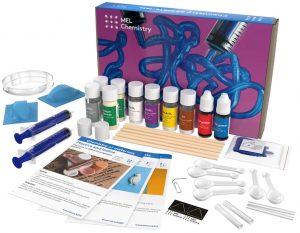
Can stone be formed from powder using water? Can squishy worms be created when two liquids are combined? How can iodine be used to distinguish different plastics? Discover the mysteries of various materials with this intriguing new set from MEL Science!
You will:
Create a sweet gypsum sculpture. Discover how a typical ion exchange reaction can produce surprising outcomes. Examine the characteristics of various polymers.
You will learn:
About the several kinds of plastics. What causes plaster to dry out, how polymers are hardened by calcium?